

Most corporate event planners can tell you how many people attended their last conference. Far fewer can tell you whether that conference actually moved the needle for the business. That gap between counting heads and proving value is exactly where corporate event benchmarking steps in. Benchmarking gives you a structured way to measure what your events actually deliver, compare those results against meaningful standards, and use that evidence to make smarter decisions. This guide covers what benchmarking is, why it matters, which metrics to track, and how to put the whole system to work.
Table of Contents
- Understanding corporate event benchmarking
- Why benchmarking is crucial for proving ROI and meeting stakeholder expectations
- Key performance indicators and metrics for effective corporate event benchmarking
- Benchmarking methods and frameworks for corporate events
- Applying corporate event benchmarking insights to enhance ROI
- Why traditional event success metrics can mislead and how benchmarking reveals true impact
- How OAK EVENTS helps optimize corporate event benchmarking and ROI
- Frequently asked questions
Key Takeaways
| Point | Details |
|---|---|
| Benchmarking overview | Corporate event benchmarking measures and compares event KPIs to find improvement opportunities and prove ROI. |
| ROI pressure gap | Many planners face intense pressure to prove impact but lack effective ROI tracking tools. |
| Effective metrics | Beyond attendance and satisfaction, use behavioral and business-outcome metrics to measure true event value. |
| Blend approaches | Combining quantitative and qualitative benchmarking, especially external comparisons, yields the best insights. |
| Practical application | Use benchmarking data to prioritize improvements, build a business case, and communicate event value clearly. |
Understanding corporate event benchmarking
Corporate event benchmarking is the practice of measuring event performance against defined baselines or peer organizations to identify gaps and improvement opportunities. It covers two dimensions: what you measure (key performance indicators, or KPIs) and how you operate (the practices and processes behind your results). Together, these give you a complete picture of where you stand and what to change.
There are four core types of benchmarking that apply directly to corporate event analysis:
- Performance benchmarking: Comparing KPI results (attendance rate, cost per attendee, lead conversion) against past events or external peers.
- Practice benchmarking: Comparing your processes and methods against organizations that consistently deliver strong event outcomes.
- Internal benchmarking: Looking across your own portfolio of events to identify which formats, formats, or teams perform best and why.
- External benchmarking: Going outside your organization to compare against industry leaders, association data, or peer companies.
Most event teams start and stop with internal data. That is understandable. Internal data is the easiest to access. But it can also create blind spots. If every edition of your annual summit improves by 5% year over year, that looks like progress until you learn that peer organizations are achieving 20% improvements by changing their format. External benchmarking is what keeps you honest and opens the door to genuine breakthroughs. For practical guidance on KPI selection for corporate events, combining all four types is the approach that delivers the clearest view of performance.
Why benchmarking is crucial for proving ROI and meeting stakeholder expectations
The pressure on event planners to demonstrate business value has intensified significantly over the past few years. Budgets are under scrutiny, and internal stakeholders increasingly expect events to justify their cost in concrete terms. The problem is that the tools and habits to deliver that proof are not yet widespread.
68% of planners report feeling significant pressure to prove business impact, yet only 30% actively use ROI analytics, and 44% have no ROI tracking in place at all. That is a serious gap. You cannot benchmark what you do not measure, and you cannot defend a budget with a chart of attendee headcounts.
"The industry-wide measurement gap is not a technology problem. It is a prioritization problem. Organizations that treat measurement as a post-event task rather than a planning requirement will always struggle to prove impact."
Benchmarking addresses this in practical ways:
- It establishes baseline data so you have something meaningful to compare future results against.
- It identifies which KPIs actually correlate with business outcomes like pipeline growth or employee engagement.
- It builds a repeatable reporting process that stakeholders can trust and expect.
- It gives you evidence to defend or grow your event budget based on demonstrated performance rather than intuition.
The importance of event benchmarking is not abstract. It is about having the right event ROI metrics ready when the CFO asks why your flagship conference costs what it does.
Key performance indicators and metrics for effective corporate event benchmarking
Not all KPIs are created equal. The metrics that appear on most post-event reports, like total attendance and satisfaction scores, are easy to collect but weak as proof of business value. That does not mean they are useless. It means they should not stand alone.
Here is a tiered approach to corporate event performance metrics:
- Foundational metrics: Registration rate, actual attendance vs. registered, no-show rate, cost per attendee. These provide operational baselines.
- Engagement metrics: Session attendance depth, app or platform interaction rate, content downloads, live poll or Q&A participation. These tell you whether people were present in mind, not just body.
- Intent and behavioral metrics: Meeting requests made at the event, demos booked, follow-up actions taken within 48 hours, content shared post-event.
- Business outcome metrics: Leads generated, pipeline influenced, contracts signed within 90 days, employee performance changes after training events.
Attendance and satisfaction alone are weak success signals. Advanced benchmarking uses behavioral and business-outcome measures like demos booked and content engagement to connect events to real results. A sales kickoff where 95% of attendees rated the experience "excellent" but none changed their prospecting behavior in the following quarter is not a success. It is a missed opportunity with a good Net Promoter Score.
Pro Tip: Set up your tracking infrastructure before the event is built, not after. Decide which behavioral and business-outcome metrics you will capture at the planning stage, then build your registration, session, and follow-up processes around collecting that data automatically.
For participant engagement techniques that generate trackable behavioral data, the key is designing interaction points directly into the agenda rather than treating engagement as a feature layer added at the end. Connecting those interactions to your broader approach of selecting effective KPIs ensures every data point you collect actually answers a business question.
Benchmarking methods and frameworks for corporate events
Knowing which metrics to track is one part of the equation. Knowing how to benchmark them effectively is the other. The approach you take will depend on your current measurement maturity, your access to external data, and the specific business questions you need to answer.
Combining quantitative performance metrics with qualitative practice benchmarking externally brings the biggest value. Pure number comparisons tell you where gaps exist. Practice benchmarking tells you why and how to close them.
Here is a practical framework for how to benchmark corporate events:
- Start with a measurement audit. Before comparing your numbers to anyone else's, establish what you are currently measuring and how reliably. Benchmarking ROI performance often starts with a capability audit before performing numeric comparisons to make those comparisons meaningful.
- Define your comparison group. Internal comparisons (across your own event portfolio) are a good starting point. External comparisons require either industry association data, peer partnerships, or third-party research reports.
- Collect data consistently across events. Inconsistent data collection is the single biggest obstacle to meaningful benchmarking. Standardize your post-event surveys, session tracking methods, and lead capture processes.
- Layer qualitative insights. Numbers show gaps. Conversations with attendees, sales teams, and session facilitators explain them.
The table below summarizes the four main event benchmarking techniques:
| Benchmarking type | Focus | Data type | Typical question answered |
|---|---|---|---|
| Performance (internal) | KPI results vs. past events | Quantitative | Are we improving over time? |
| Performance (external) | KPI results vs. peers | Quantitative | How do we compare to industry? |
| Practice (internal) | Process differences across teams | Qualitative + quantitative | Which internal approach works best? |
| Practice (external) | Methods used by top performers | Qualitative | What should we do differently? |
Pro Tip: Do not rely only on post-event survey data for qualitative insights. Short interviews with your top ten attendees and three or four internal stakeholders, conducted within one week of the event, consistently surface insights that surveys miss entirely.
When choosing event management platforms, prioritize platforms that capture behavioral data automatically. Manual data collection introduces errors and delays that erode the quality of your benchmarking.

Applying corporate event benchmarking insights to enhance ROI
Collecting benchmarking data is only valuable if it drives action. The analysis phase is where many teams stall. They gather solid data, produce a report, and then struggle to translate findings into decisions that leadership will act on.
Here is a practical approach to using benchmarking results effectively:
- Identify your highest-impact gaps. Not all gaps are equal. A 15% shortfall in session engagement matters more than a 3% drop in catering satisfaction. Prioritize gaps that directly connect to business outcomes.
- Map gaps to specific causes. Use both your quantitative data and qualitative insights to understand root causes. Low post-event lead follow-up rates might indicate a process problem in sales, not a content problem in the event.
- Select one to three improvements per event cycle. Trying to fix everything at once spreads attention thin. Focus on changes with the clearest evidence base and the most direct path to measurable ROI improvement.
- Implement, track, and re-measure. Set a specific KPI target for each change, implement it at the next event, and compare results.
- Document and share. Build a benchmarking record that spans multiple event editions so you can show trends over time, not just snapshots.
Organizations that connect event data to business outcomes are better positioned to secure budget and prove impact. To communicate benchmarking insights to stakeholders effectively:
- Frame findings in business language (pipeline, retention, productivity) rather than event language (session ratings, registration counts).
- Use visual comparisons to peer benchmarks when available. Stakeholders respond to competitive context.
- Present trends across multiple events, not just the most recent one. A single data point is anecdote. Three or more is evidence.
For teams running planning hybrid corporate events at scale, this discipline around benchmarking becomes even more critical. Hybrid formats introduce more data streams and more complexity, which makes consistent frameworks essential.
Why traditional event success metrics can mislead and how benchmarking reveals true impact
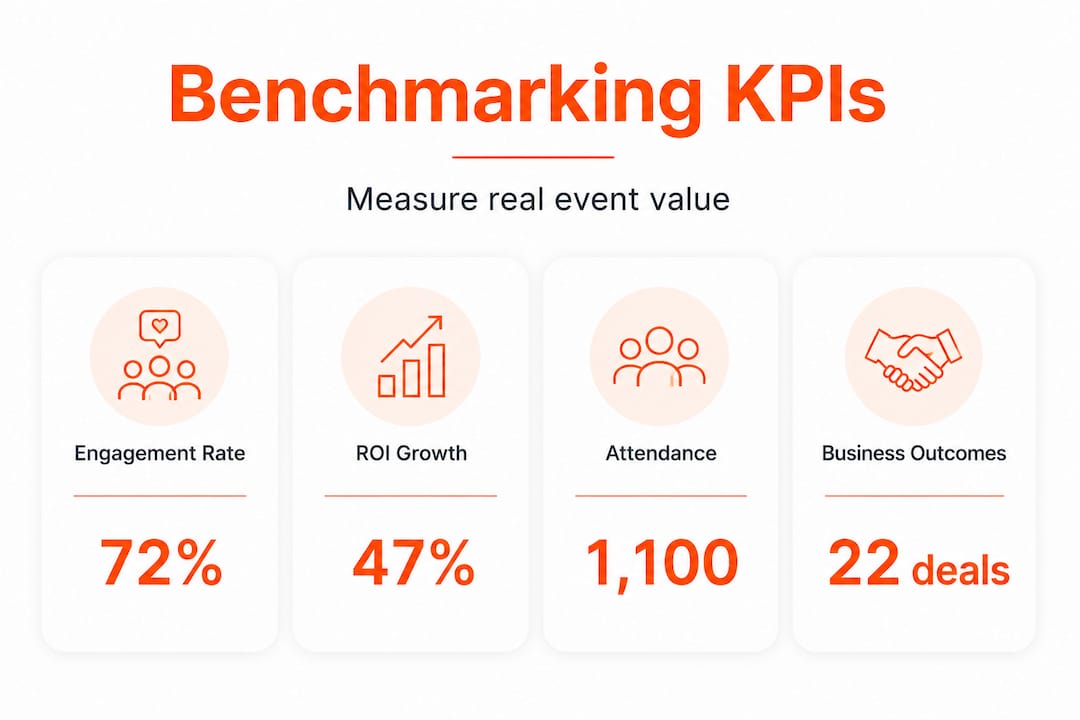
Here is an uncomfortable truth about event measurement: a high satisfaction score and a packed auditorium can coexist with an event that delivered almost no measurable business value. It happens more often than most planners would admit.
Attendance figures and satisfaction ratings measure whether people showed up and whether they had a pleasant experience. Those are reasonable baseline signals. But they say nothing about whether participants changed their behavior, advanced a business relationship, or applied new knowledge in a way that affected performance.
Attendance and satisfaction do not guarantee value. True impact is measured by post-event actions, engagement, and business outcomes. An annual sales conference where every rep gives a 9 out of 10 but conversion rates do not improve is not an event success. It is an expensive team dinner with a keynote.
The deeper issue is that vanity metrics create false confidence. When planners report record attendance and glowing feedback surveys year after year, they rarely face hard questions. That lack of scrutiny reduces the incentive to go deeper, which means the true performance gap never gets addressed.
Benchmarking against advanced event KPIs breaks that cycle. When you measure behavioral engagement and post-event business actions alongside satisfaction, you start to see correlations that change how you design events. Sessions with strong behavioral follow-through often differ structurally from sessions attendees simply enjoyed. That knowledge is actionable. A high satisfaction rating alone is not.
The other dimension worth addressing is cultural. Building a genuine benchmarking practice requires a level of organizational humility: the willingness to look at external leaders and say, "They are doing this better than we are, and here is what we can learn." That openness is what separates teams that improve steadily from those that polish the same event year after year without substantive progress.
How OAK EVENTS helps optimize corporate event benchmarking and ROI
Proving the value of your events should not require assembling data from five different tools and building custom spreadsheets after every edition. When your measurement infrastructure is fragmented, benchmarking becomes a project in itself rather than a natural output of your event process.
OAK EVENTS is a platform built specifically for enterprise event teams that need to track, analyze, and act on event data without the operational overhead. From registration and check-in through session engagement and post-event reporting, every interaction generates data that feeds directly into your measuring event success framework. For teams managing corporate events in media and tech sectors, OAK EVENTS supports CRM integration, custom KPI dashboards, and the kind of detailed behavioral tracking that makes benchmarking actionable rather than aspirational. The result is a reporting process stakeholders trust and event data that actually drives decisions.
Frequently asked questions
What is corporate event benchmarking?
Corporate event benchmarking is the process of measuring event performance and comparing it against internal data or external peers to identify areas for improvement and best practices. It covers both what you measure (KPIs) and how you operate.
Why is benchmarking important for corporate event ROI?
Benchmarking helps planners identify gaps in measuring and proving ROI so they can meet stakeholder expectations with real data. 68% of planners report pressure to prove business impact, yet most lack the tracking systems to do it reliably.
What key metrics should be used in corporate event benchmarking?
Planners should use a layered mix that includes foundational metrics (attendance, cost per attendee), engagement metrics (session participation, platform interaction), and business-outcome metrics like leads generated or pipeline influenced. High-performing frameworks add behavioral and intent measures to connect experience to ROI.
How can event planners start benchmarking if they lack ROI data?
Start with a measurement capability audit: identify what you currently track, where the gaps are, and put minimum tracking tools in place before attempting numeric comparisons. Benchmarking ROI performance only becomes meaningful once your data collection is consistent enough to trust.
How does OAK EVENTS support corporate event benchmarking?
OAK EVENTS offers a platform with built-in KPI tracking, CRM integrations, and detailed reporting features designed to make data collection automatic and benchmarking accessible for enterprise event teams.