

Running a corporate event with five different tools for registration, communications, check-in, streaming, and reporting is not a workflow. It's a liability. What is end-to-end event management? It's the answer to that fragmented reality: a fully integrated approach that covers every phase of an event from initial concept through post-event analysis, under a single, unified strategy. For corporate planners managing multi-day conferences, hybrid roadshows, or large-scale trade shows, the difference between fragmented and integrated management is the difference between a stressful scramble and a measurable success.
Table of Contents
- What is end-to-end event management?
- The full event lifecycle: stages from concept to post-event
- Benefits and challenges of end-to-end event management software
- How end-to-end event management enhances participant engagement and ROI measurement
- Choosing the right end-to-end event management approach for your event type
- Why end-to-end event management is essential for modern corporate planners
- How OAK EVENTS supports your end-to-end event management needs
- Frequently asked questions
Key Takeaways
| Point | Details |
|---|---|
| Comprehensive integration | End-to-end event management unifies all stages from concept to post-event analysis into one coordinated process. |
| Efficiency & clarity | Having one team or platform managing the full event lifecycle reduces errors, miscommunication, and wasted resources. |
| Enhanced engagement | Modern event technology integrated across phases significantly boosts attendee experience and participation. |
| Data-driven ROI | Post-event analytics from an integrated system provide precise insights to prove event success and guide improvements. |
| Tailored approach | Choosing the right strategies and tools depends on event format and audience needs for optimal results. |
What is end-to-end event management?
End-to-end event management is not simply a checklist. It's a philosophy of how events should be planned, executed, and evaluated. As defined by event professionals, end-to-end refers to a fully integrated approach covering every stage of an event from initial concept and planning, through delivery, to post-event analysis and reporting.
The key word here is integrated. Rather than treating registration, marketing, on-site logistics, and post-event reporting as separate workstreams handled by different teams and tools, end-to-end event management unifies them under shared goals, shared data, and shared accountability.

What does that look like in practice? Consider a multi-city product launch for a technology company. Without an integrated approach, the marketing team builds one campaign, the logistics team books venues independently, and the analytics team scrambles after the fact to piece together attendance data. With end-to-end event planning, every one of those functions is connected from day one.
The core components of end-to-end event management include:
- Unified goal-setting across all teams and vendors before planning begins
- Centralized data so registration numbers, engagement metrics, and feedback live in one place
- Coordinated communications from pre-event promotion through post-event follow-up
- Integrated technology that handles registration, check-in, streaming, and reporting without manual data transfers
- Consistent attendee experience across all touchpoints, whether in-person, virtual, or hybrid
You can explore more on event planning resources to see how these principles apply across different event formats and industries.
The full event lifecycle: stages from concept to post-event
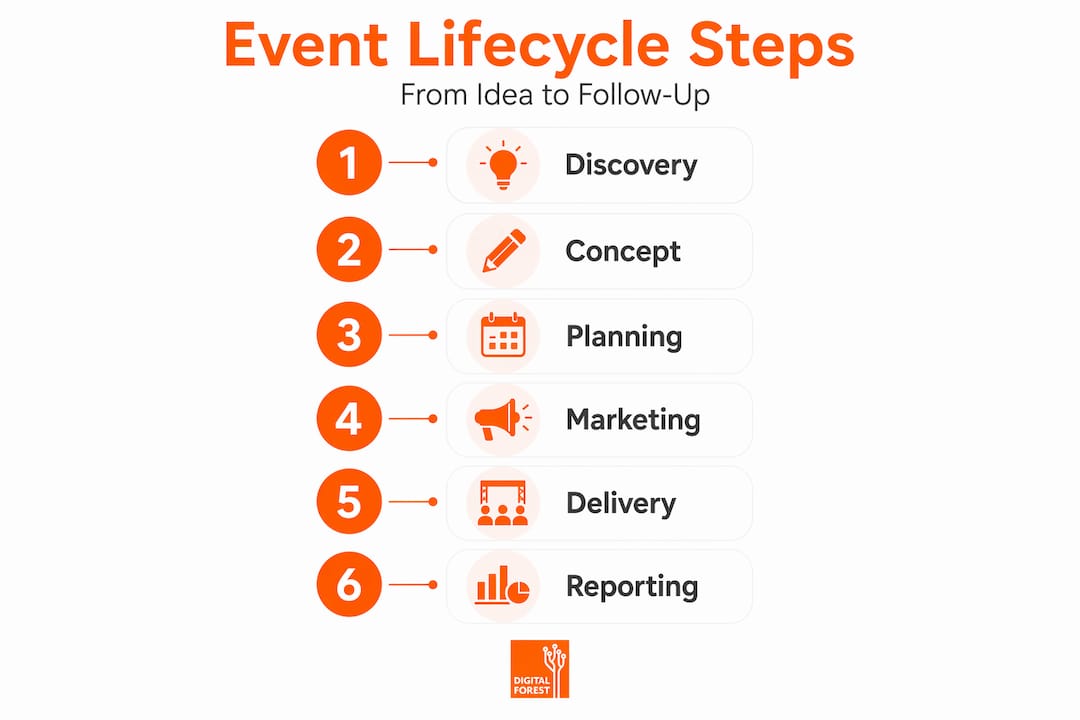
Understanding what end-to-end event management means sets the stage to explore its complete lifecycle step-by-step. A strong event process typically includes discovery and strategy, concept development, technical planning, marketing, delivery, and post-event analysis. Each phase feeds directly into the next.
-
Discovery and strategy. Define the event's purpose, target audience, and success metrics before anything else. A conference without a clear KPI framework is just a gathering. This stage sets the foundation that every subsequent decision rests on.
-
Concept and creative development. Design the event's theme, messaging, and attendee journey. For hybrid events especially, this means thinking about how the experience translates across both physical and digital environments, not just replicating the in-room experience on a screen.
-
Technical and logistical planning. Venue selection, AV setup, streaming infrastructure, safety protocols, and vendor coordination all happen here. Poor planning at this stage is the single most common cause of on-site failures.
-
Marketing and promotion. Targeted campaigns, speaker announcements, early-bird registration, and audience segmentation drive attendance and build anticipation. This phase should be tightly connected to your CRM so you can track which channels convert.
-
Delivery and on-site management. Execution day. The quality of your preparation shows here. Real-time coordination, check-in management, live engagement tools, and contingency planning all come into play.
-
Post-event analysis. Attendance rates, session engagement, survey results, lead generation numbers, and ROI calculations. This phase is where events prove their value to stakeholders and where insights are captured for future editions.
When choosing event platforms, look for solutions that support all six stages natively rather than requiring separate tools for each. And if hybrid formats are part of your program, a dedicated hybrid event planning guide can help you navigate the additional complexity those formats introduce.
Benefits and challenges of end-to-end event management software
Having outlined the process, it's important to understand how software supports end-to-end management and where it excels or falls short.
End-to-end software integrates tasks from registration to analytics in one platform, reducing time and resource needs. That's the core value proposition. But the benefits go further than efficiency.
Key benefits:
- Reduced miscommunication. When all teams work from the same platform, there's no version-control problem with attendee lists or conflicting speaker schedules.
- Faster reporting. Data collected during registration and check-in flows directly into post-event dashboards without manual exports.
- Better attendee experience. Integrated platforms can personalize communications, recommend sessions, and send real-time updates without requiring separate tools.
- AI-powered engagement. Modern platforms include features like matchmaking, live polling, and personalized agendas that increase participation and satisfaction scores.
Potential limitations:
- Smaller or one-off events may not need the full feature set, making a comprehensive platform feel like overkill.
- Highly specific technical requirements (custom integrations, niche compliance standards) may not be fully covered by a single platform.
- Onboarding takes time. Teams accustomed to their existing tools need training and transition support.
| Feature area | Fragmented tools | End-to-end platform |
|---|---|---|
| Registration and check-in | Separate systems, manual sync | Unified, real-time data |
| Attendee communications | Multiple email tools | Centralized, segmented |
| Streaming and virtual | Third-party add-ons | Native integration |
| Analytics and reporting | Manual data aggregation | Automated dashboards |
| CRM integration | Custom connectors required | Built-in or standard API |
Pro Tip: Before selecting event management software, map out your actual event lifecycle and identify where data handoffs currently break down. Those friction points are exactly where an integrated platform delivers the most value.
How end-to-end event management enhances participant engagement and ROI measurement
With software benefits established, let's explore the direct impact on engagement and ROI, which are the two metrics corporate planners are most accountable for.
The numbers are clear: 73% of attendees expect in-person conferences to use modern event technology, and 79% of organizers integrate platforms with CRM or marketing automation for measurement. Those figures reflect a shift in attendee expectations that fragmented tools simply cannot meet.
Integrated management improves engagement in several concrete ways:
- Mobile apps give attendees personalized schedules, real-time notifications, and networking tools. They also collect behavioral data that shows which sessions drove the most interest.
- Unified communications mean attendees receive consistent, timely messages before, during, and after the event rather than disjointed emails from different systems.
- Live engagement tools like Q&A, polling, and gamification are more effective when they connect directly to your event platform rather than operating as standalone widgets.
On the ROI side, integrated platforms make measurement practical rather than aspirational. Post-event dashboards can show lead generation by session, engagement rates by audience segment, and conversion data tied back to specific marketing touchpoints.
Pro Tip: Build your KPI framework before the event, not after. Decide what "success" looks like in measurable terms during the discovery phase, then configure your platform to capture that data automatically throughout the event lifecycle.
Continuous improvement is the real long-term benefit. Each event generates a dataset that informs the next one. Visit the event engagement strategies section for practical examples of how planners are using post-event data to improve registration rates and session quality year over year.
Choosing the right end-to-end event management approach for your event type
After understanding benefits and impact, let's clarify how to apply end-to-end management tailored to your specific event formats. Not every event has the same requirements, and your management approach should reflect that.
Events now operate as core growth infrastructure, with integrated systems emphasizing impact over scale. That means even a 200-person internal training session deserves the same structured approach as a 5,000-person trade show, scaled appropriately.
Matching approach to event format:
| Event type | Key management priorities | Technology focus |
|---|---|---|
| In-person conference | Venue logistics, check-in, networking | Badge printing, session tracking, mobile app |
| Virtual event | Streaming quality, digital engagement | Streaming integration, virtual networking, analytics |
| Hybrid event | Dual-audience experience, AV coordination | Unified platform with both physical and digital modules |
| Multi-city roadshow | Consistency across locations, local logistics | Centralized data with location-level reporting |
Factors to evaluate when selecting your approach:
- Audience size and geographic distribution
- Level of interactivity expected (keynotes only vs. workshops and networking)
- Integration requirements with existing CRM, SSO, or marketing tools
- Internal team capacity versus need for managed services
Steps to evaluate and select your event management partner:
- Audit your current tool stack and identify where data gets lost or duplicated.
- Define your non-negotiable features based on your most complex event type.
- Request demos focused on your specific use cases, not generic feature tours.
- Evaluate support models, not just software features. Onboarding and live-event support matter as much as functionality.
- Review case studies relevant to your sector. A real-world implementation example can reveal how platforms perform under actual event conditions.
For organizations in the media and technology space, the complexity of media and technology events management often requires platforms that handle both high-volume streaming and detailed sponsor reporting simultaneously. And for teams new to hybrid formats, a structured organizing hybrid events approach ensures both audiences receive equal attention.
Why end-to-end event management is essential for modern corporate planners
Here's a perspective that most event management articles avoid: the real cost of fragmented planning is not inefficiency. It's invisibility. When your event data lives across five platforms, you cannot tell a coherent story about what the event achieved. And if you cannot tell that story, your event budget is always at risk.
Teams treating events as long-term systems secure sustained investment and drive measurable business outcomes. That's not a coincidence. It's the direct result of having unified data that proves value to stakeholders consistently, year after year.
The planners who struggle most are not those who lack creativity or effort. They're the ones managing complexity with tools that were never designed to work together. A registration platform that doesn't talk to your email system. A check-in app that doesn't feed your CRM. A post-event survey tool that exports to a spreadsheet no one reads. Each gap is a place where insight disappears.
End-to-end event management closes those gaps by design. It's not a luxury for large enterprises. It's a practical necessity for any planner who needs to justify their event budget, improve year-over-year performance, and deliver consistent attendee experiences across formats.
The shift from "we ran the event" to "here's what the event delivered" is entirely dependent on having integrated systems in place before the event begins. That shift is what separates event programs that grow from those that stagnate.
Explore more event management insights to see how other corporate planners are making this transition and the results they're achieving.
How OAK EVENTS supports your end-to-end event management needs
Managing a complex corporate event from concept to post-event reporting is demanding. The right partner makes that process measurable, not just manageable.
OAK EVENTS is a SaaS platform built specifically for corporate planners who need unified control over in-person, virtual, and hybrid events. From registration and check-in to streaming integration, attendee engagement, and detailed KPI reporting, every function lives in one place. The platform supports complex formats including multi-day conferences, trade shows, and multi-city roadshows, with modules for sponsorship management, content delivery, and targeted communications. Tailored CRM and SSO integrations mean your event data connects directly to your existing business systems. Visit the event management blog to see how organizations are using OAK EVENTS to turn events into measurable growth channels.
Frequently asked questions
What stages are included in end-to-end event management?
A strong event process includes discovery and strategy, concept development, technical planning, marketing, delivery, and post-event analysis, with each phase building directly on the last.
How does end-to-end event management improve attendee engagement?
By integrating modern technology like mobile apps and unifying all communications, it enables real-time interaction and a consistent experience. 73% of attendees expect modern event technology, and mobile apps in particular can significantly shape overall satisfaction.
What are the main benefits of end-to-end event management software?
End-to-end software integrates registration through analytics into one platform, reducing time and resource needs while giving planners centralized control over every operational function.
Is end-to-end event management suitable for virtual and hybrid events?
Yes. End-to-end services manage technical production for virtual and hybrid events, ensuring smooth execution across both physical and digital environments with coordinated vendor and participant management.