
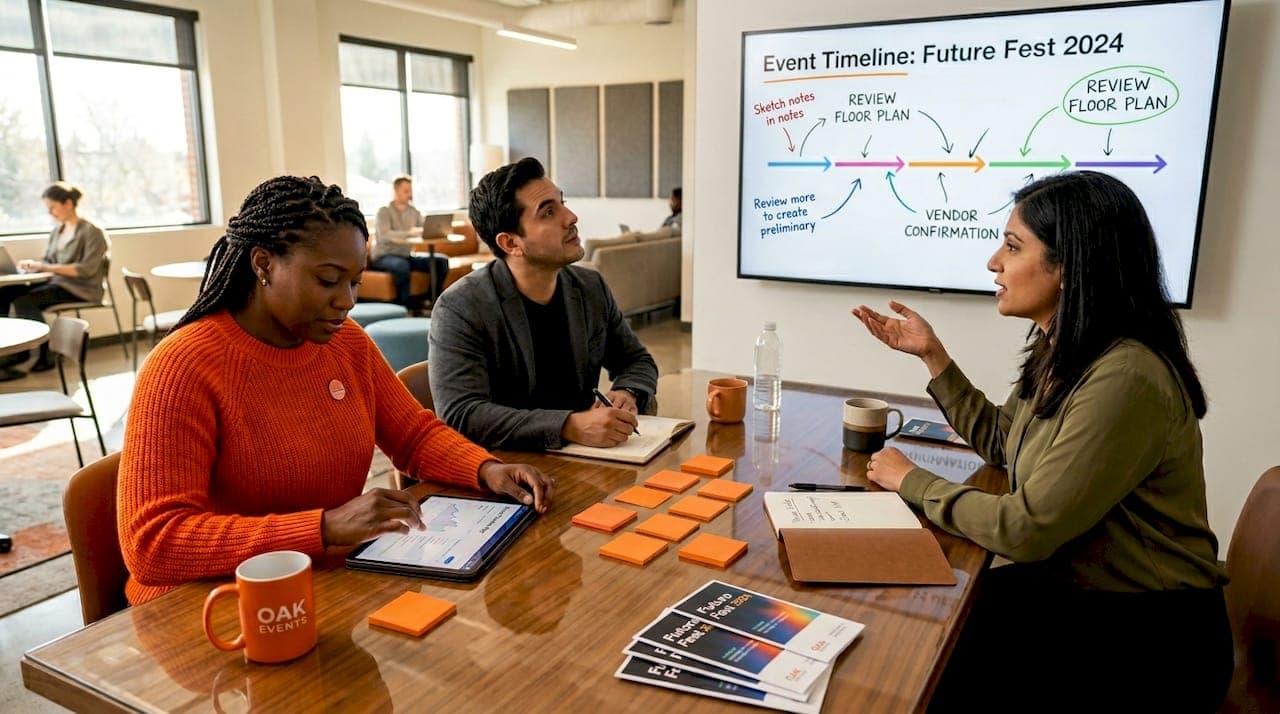
Enterprise event teams often report strong attendance numbers, only to struggle when stakeholders ask what those events actually produced. The disconnect is real and common. Lifecycle management covers an end-to-end operating flow that explicitly includes planning, goal setting, invite and registration, execution with attendance capture, and post-event analysis tied to KPIs and outcomes. This guide breaks down every phase of that lifecycle, explains where enterprise teams typically lose value, and gives you the frameworks to connect every touchpoint for stronger engagement and real, demonstrable ROI.
Table of Contents
- What is event lifecycle management?
- The business case: why lifecycle management drives engagement and ROI
- Enterprise event lifecycle: typical workflows and best practices
- Common pitfalls and how to avoid them in event lifecycle management
- A fresh perspective: why ROI is won or lost before the event starts
- Ready to optimize your event lifecycle management?
- Frequently asked questions
Key Takeaways
| Point | Details |
|---|---|
| End-to-end process | Event lifecycle management covers planning, execution, and analysis—not just the event day. |
| Drives ROI | Lifecycle management connects engagement data to measurable business outcomes and pipeline impact. |
| Workflow integration | Successful enterprises orchestrate event workflows across platforms and teams for seamless execution. |
| Pitfall prevention | The top cause of wasted ROI is poor upfront planning and fragmented data handoff. |
What is event lifecycle management?
Event lifecycle management is the practice of treating an event not as a single day on the calendar, but as a continuous business process with defined stages, measurable outputs, and clear connections to organizational goals. It replaces the fragmented, task-by-task approach with a structured flow that begins well before invitations go out and continues long after attendees go home.
The event management lifecycle is built around four core phases: Plan, Invite and Register, Execute, and Analyze. Each phase feeds the next, and skipping or shortchanging any one of them creates gaps that undermine the entire program.
Here is what each phase typically involves:
- Plan: Define objectives, target audiences, budgets, and success metrics. Identify technology requirements and integration needs (CRM, SSO, registration platforms). Assign roles and establish workflow dependencies.
- Invite and Register: Build and segment invitation lists, deploy branded registration flows, collect attendee data, and manage confirmations and reminders. This phase generates the first wave of behavioral data.
- Execute: Run the event, capture real-time attendance and engagement signals (session check-ins, poll responses, networking interactions), and ensure data flows to the right systems without manual intervention.
- Analyze: Measure outcomes against pre-defined KPIs, generate reports for stakeholders, identify pipeline impact, and feed insights back into the planning phase for future events.
When choosing event management platforms, one of the most important criteria is whether the platform supports all four phases in a connected way, rather than requiring separate tools that don't communicate with each other.
| Phase | Primary objective | Key outputs |
|---|---|---|
| Plan | Align event goals with business strategy | Event brief, budget, KPI framework |
| Invite and Register | Build qualified audience and capture baseline data | Registration data, segmentation lists |
| Execute | Deliver experience and capture behavioral signals | Attendance records, engagement scores |
| Analyze | Measure ROI and inform future programs | KPI reports, CRM updates, pipeline data |
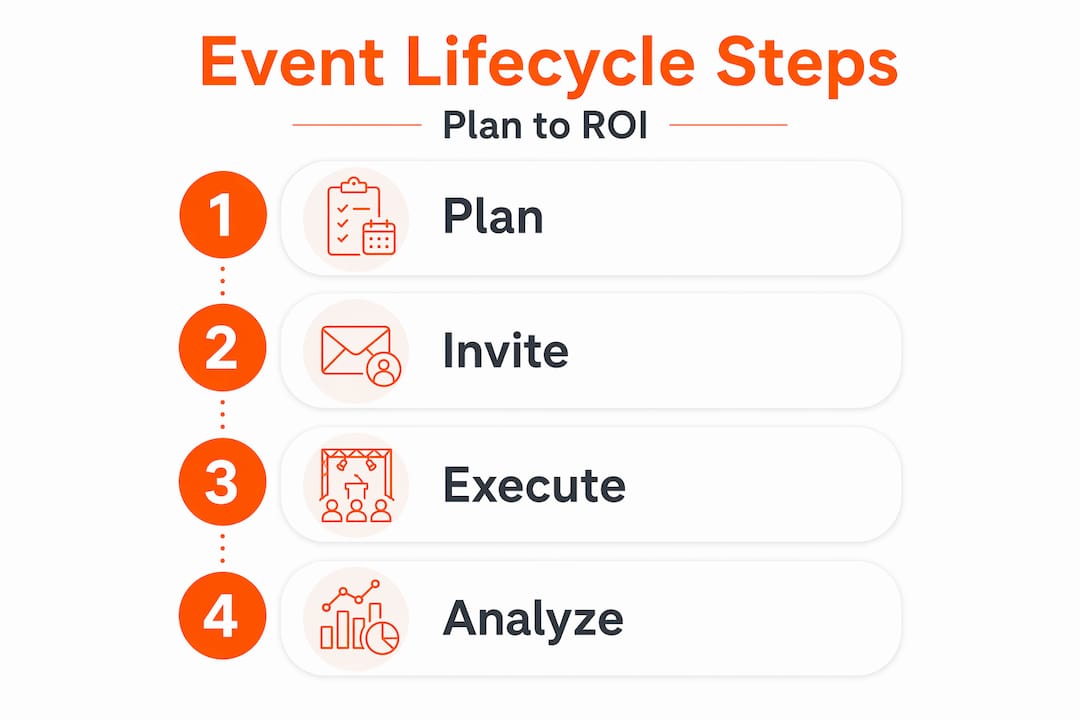
The table above makes one thing clear: each phase produces something concrete. When those outputs are connected, the event becomes a data-generating business asset, not just a logistics exercise.
The business case: why lifecycle management drives engagement and ROI
With a solid lifecycle framework in mind, why is this connected approach superior to traditional one-and-done event models? The answer lies in what gets measured and when.
Traditional event programs treat the event day as the primary measurement window. Attendance is counted, a post-event survey is sent, and a summary slide deck is prepared. But this approach misses the majority of the behavioral signals that indicate real engagement and business intent. Connecting pre- and post-event touchpoints and converting onsite behavioral data into actions and outcomes is what separates high-performing event programs from average ones.
Consider how behavioral data accumulates across the lifecycle. Before the event, registration patterns reveal which audience segments are most responsive to specific messaging. During the event, session attendance, content downloads, and networking activity indicate which topics and formats resonate. After the event, email open rates, content consumption, and sales conversations complete the picture. None of these signals exist in isolation. Together, they form a behavioral profile that sales and marketing teams can act on immediately.
Here is a numbered process for connecting event data to measurable business value:
- Pre-event: Capture registration source, job title, company size, and content preferences. Push this data to your CRM so sales reps have context before the event begins.
- Day-of: Use real-time check-in and session tracking to identify high-engagement attendees. Flag anyone who attends multiple sessions on a specific product or topic as a warm lead.
- Post-event: Trigger automated follow-up sequences based on engagement scores, not just attendance status. A person who attended three sessions and downloaded two resources should receive a different message than someone who checked in and left.
This approach directly improves attendee engagement because communications become relevant and timely rather than generic. It also strengthens event success metrics because every touchpoint is tracked and attributed.
Pro Tip: Don't wait for post-event surveys to measure engagement. Real-time touchpoints such as live polls, session check-ins, and app interactions give you actionable data while the event is still happening. Use that data to adjust the program on the fly and to prioritize follow-up outreach immediately after the event closes.

The ROI case is straightforward. When event data flows into CRM and pipeline systems, revenue teams can attribute deals and opportunities directly to event interactions. Without that flow, events remain a cost center with no clear line to revenue.
Enterprise event lifecycle: typical workflows and best practices
Knowing lifecycle management's value, how do enterprises actually put it into practice and avoid workflow bottlenecks? The answer is orchestration. Workflows knit together technology and people across every phase, ensuring that the right data reaches the right system at the right time.
A typical enterprise event workflow looks like this. In the pre-event phase, the team sequences tasks across registration setup, CRM integration, email campaigns, and speaker coordination. Dependencies are mapped so that nothing launches until prerequisites are complete. For example, the confirmation email sequence cannot go live until registration fields are finalized and CRM mapping is tested.
During execution, real-time attendance capture feeds directly into the event platform's engagement dashboard. Staff at check-in points use mobile or badge scanning tools that sync instantly with the central system. Session tracking is automated, removing the need for manual headcounts or paper sign-in sheets.
After the event, workflow automation handles the handoff from event platform to CRM, marketing automation, and reporting tools. Engagement scores are calculated, lead lists are segmented, and follow-up sequences are triggered without requiring manual exports or data cleaning.
| Aspect | Traditional event management | Workflow-driven lifecycle management |
|---|---|---|
| Data capture | Manual, post-event | Automated, real-time |
| CRM updates | Manual export after event | Live sync during and after event |
| Follow-up timing | Days or weeks post-event | Hours post-event, triggered by behavior |
| ROI measurement | Attendance and survey data only | Full-funnel attribution across all phases |
| Tool integration | Separate tools, manual handoffs | Connected platform with native integrations |
The contrast is significant. Workflow-driven management doesn't just save time. It fundamentally changes the quality and speed of the data your teams work with.
Best practices for enterprise event workflows include:
- Sequence tasks explicitly. Map every dependency before launch. Know which tasks block others and assign clear owners.
- Design data handoffs in advance. Decide how registration data maps to CRM fields before the registration page goes live, not after the event.
- Test integrations early. Run end-to-end integration tests at least two weeks before the event to catch sync errors, field mapping issues, or authentication failures.
- Use real-time dashboards. Give event managers and sales leads access to live engagement data during the event so they can act on it immediately.
- Build post-event automation. Automate follow-up sequences, CRM updates, and reporting exports so the team can focus on analysis rather than data hygiene.
When selecting event tech platforms, prioritize platforms that support these workflows natively rather than requiring custom development or third-party middleware for every integration.
Pro Tip: Audit your event workflow before launch. Map every dependency, identify every manual handoff, and ask whether each one can be automated. Dependencies are the number one source of delays and data errors in enterprise event programs. A pre-launch audit typically surfaces three to five fixable issues that would otherwise surface on event day.
Common pitfalls and how to avoid them in event lifecycle management
Implementing workflows can deliver high ROI, but only if you're aware of and actively avoid these common traps. Most enterprise event programs don't fail because of poor content or low attendance. They fail because of structural problems in how data is captured, managed, and handed off.
"Events often fail to realize ROI if program measurements and data handoffs are not designed up front. The measurement framework must be established before the event, not retrofitted after it." — Measuring Event ROI, Integrate
This diagnosis is accurate and consistent with what enterprise event teams experience repeatedly. The most common failure points are:
-
Siloed data. Registration data lives in one system, attendance data in another, and survey responses in a third. No one has a complete picture of any individual attendee, and building a unified view requires manual effort that rarely happens at scale.
Fix: Choose a platform with native CRM integration and define your data schema before registration opens. Every field collected should have a clear destination in your CRM or marketing automation system.
-
Fragmented measurement. Teams measure attendance and survey satisfaction but don't connect those metrics to pipeline or revenue outcomes. Stakeholders see activity data, not business impact.
Fix: Define your measuring event ROI framework before the event. Identify which KPIs map to business goals, and build your reporting structure around those KPIs from the start.
-
Poor handoff from event to business teams. Sales reps receive a flat list of attendees days after the event with no context about who engaged with what. The window for timely follow-up closes before it opens.
Fix: Automate the handoff. Use engagement scoring to segment attendees by interest level and product affinity. Deliver that segmented list to sales within hours of the event closing, not days.
-
No post-event nurture design. The event ends and communication stops. Attendees who showed strong interest receive a generic thank-you email and nothing else for weeks.
Fix: Design post-event nurture sequences before the event. Map content to engagement signals so that follow-up is relevant and timely.
-
Treating events as standalone projects. When events are managed as one-off projects rather than components of an ongoing program, learnings don't accumulate and improvements don't compound.
Fix: Build a post-event review process that feeds insights directly into the planning phase of the next event. Lifecycle management is circular, not linear.
Pro Tip: Design your data capture and handoff flow before the event, not after. The decisions you make in the planning phase determine whether your post-event analysis is actionable or merely descriptive. Spend time here and you will save significant effort everywhere else.
A fresh perspective: why ROI is won or lost before the event starts
Here is an honest observation that many event teams resist: the quality of your post-event results is almost entirely determined by decisions made in the planning phase. Execution matters, of course. But execution can only deliver what the planning phase made possible.
Most enterprise event planners invest heavily in content, production, and logistics. These are visible, tangible, and easy to justify. What gets underinvested is the upfront work of integrating event data into CRM and pipeline processes, defining KPIs that connect to business outcomes, and designing workflow handoffs that don't require heroic manual effort after the event closes.
In practice, teams that treat the event as a standalone project consistently struggle to justify ROI to leadership. They have attendance numbers and satisfaction scores, but they can't show pipeline influence or revenue attribution. That's not a measurement problem. It's a design problem. The measurement infrastructure wasn't built before the event started.
The teams that consistently demonstrate strong event ROI share one characteristic: they spend as much time designing the data and workflow architecture as they spend on the event program itself. They know exactly which engagement strategies will generate the behavioral signals they need, and they have systems in place to capture and act on those signals in real time.
The uncomfortable truth is that a well-executed event with poor data architecture will always underperform a moderately executed event with excellent data architecture. ROI is built in the planning phase. Everything else is delivery.
Ready to optimize your event lifecycle management?
Enterprise event programs that consistently deliver measurable ROI share one thing in common: they run on integrated, purpose-built platforms that support every phase of the lifecycle without requiring manual workarounds or disconnected tools.
OAK EVENTS is built specifically for this challenge. The platform connects registration, check-in, real-time engagement, CRM integration, and post-event analytics in a single environment, so your team can focus on strategy rather than data hygiene. Whether you manage multi-day conferences, trade shows, or multi-city roadshows, the OAK EVENTS platform scales to your program's complexity. For teams in fast-moving sectors, the event solutions for media and tech module offers tailored workflows and reporting frameworks designed for high-volume, high-stakes event programs. If you're ready to close the gap between event activity and business outcomes, OAK EVENTS is the place to start.
Frequently asked questions
What are the stages of event lifecycle management in an enterprise?
The four stages are plan, invite and register, execute, and analyze, with each phase linked to defined KPIs and business outcomes. Every stage produces data that feeds directly into the next.
How does event lifecycle management improve ROI?
It ties every phase from pre-event touchpoints through post-event analytics to business outcomes, ensuring behavioral data drives conversion and pipeline impact rather than sitting unused in disconnected systems.
What is a common mistake in event lifecycle management?
The most frequent error is failing to plan how event data is captured and handed off to business systems, which fragments measurement and makes it impossible to attribute revenue to event activity.
Can event lifecycle management be automated?
Yes. By orchestrating workflows across registration, check-in, surveys, and CRM systems, teams can automate data handoffs, follow-up sequences, and reporting, reducing manual effort and accelerating post-event action.