

Enterprise marketing managers and event planners face a consistent challenge: the most innovative event management technology rarely sells itself. Decision-makers at large organizations are not moved by feature lists or polished demos alone. They need to see a direct connection between your solution and their business outcomes, whether that means more qualified leads, stronger retention, or measurable pipeline growth. This guide walks through a proven, consultative framework for building and delivering event tech pitches that resonate at the executive and stakeholder level.
Table of Contents
-
Deliver your pitch with consultative, partnership-focused style
-
Why KPIs and measurement models win over creativity—and what most pitches miss
Key Takeaways
| Point | Details |
|---|---|
| Lead with client KPIs | Successful pitches start by mapping your solution directly to the client’s business goals and key performance indicators. |
| Make it measurable | Tie every tech feature and proposal milestone to a concrete business outcome that decision-makers care about. |
| Prove ROI with data | Support your pitch with real-world data, clear metrics, and social proof to win over enterprise buyers. |
| Adopt a consultative style | Position yourself as a problem-solver and long-term partner, not just a vendor pushing features. |
| Avoid common pitfalls | Don’t let creative tech overshadow integration, reporting, and measurable ROI—these are crucial for enterprise buy-in. |
Understand what clients really care about
To start a persuasive pitch, you must understand what matters most to your client. Before you mention a single feature, you need a clear picture of the business problems your client is trying to solve. That means doing real discovery work, not just reviewing their website.
Enterprise clients care about their own metrics first. Common KPIs that drive their decisions include:
-
Lead generation and pipeline contribution from events
-
Attendee engagement rates and session participation
-
Net Promoter Score (NPS) and customer satisfaction (CSAT)
-
Revenue attribution tied to event activity
-
Retention and renewal rates influenced by event touchpoints
Each of these indicators tells a different story about what success looks like for your client. A technology company running a user conference has very different priorities than a financial services firm hosting a regulatory training series. Your pitch must reflect that difference.
Strong discovery questions help you get there. Ask things like: “What does a successful event look like for your leadership team?” or “How are you currently measuring the business impact of your events?” These questions surface the real concerns behind the request, whether it’s fear of low attendance, difficulty proving ROI to the CFO, or frustration with disconnected tools.
“Enterprise event tech positioning should be explicitly customer-centric and tied to the client’s KPIs, not vendor features, with evidence, social proof, and a consultative tone.”
Avoid leading with technical jargon until you can frame its value in the client’s language. If a client cares about measuring participant engagement, explain how your platform tracks session dwell time, interaction rates, and poll responses, and then connect those data points directly to their stated goals. Knowing which event KPIs matter to each client is the foundation of every effective pitch.
Pro Tip: Always open with their goals, not your features. Spend the first 20% of any pitch conversation listening and asking questions. It signals that you are a partner, not a vendor.
Build a customer-centric proposal foundation
With a clear understanding of the client’s priorities, structure your proposal so every element addresses their business case. A well-organized proposal does more than describe your solution. It shows stakeholders that you understand their environment and have thought through delivery from start to finish.
A strong event proposal aligns event objectives with measurable outcomes, provides a clear timeline with milestones, and maps out logistics, staffing, and technical requirements so stakeholders can evaluate delivery confidence at a glance.
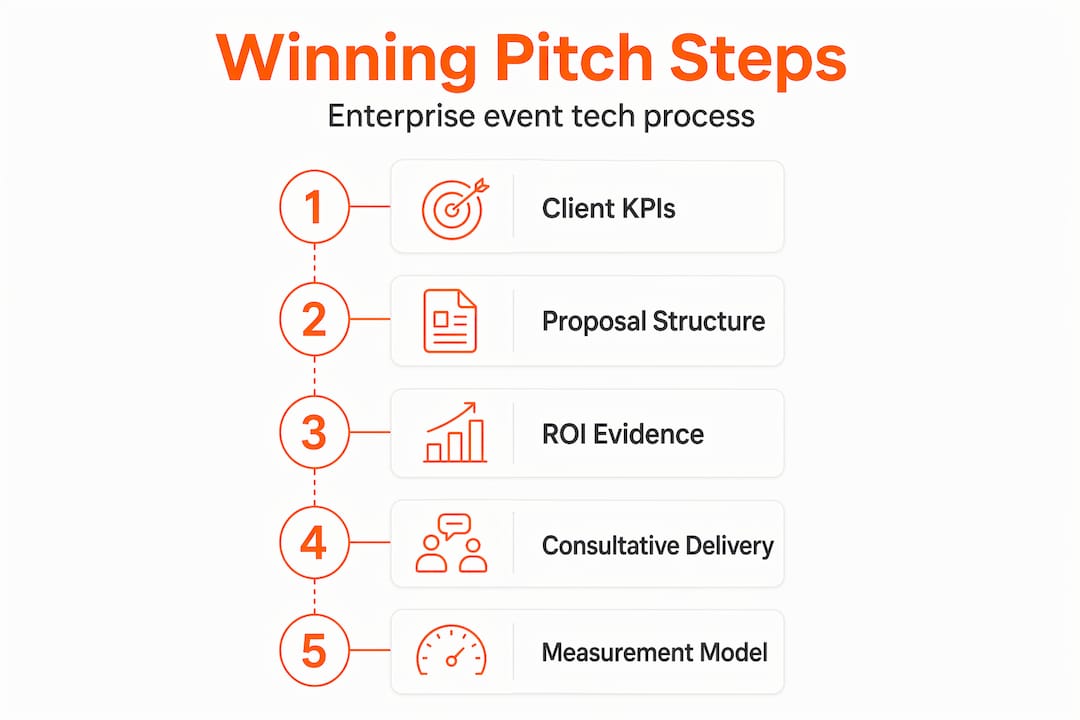
Here is a comparison of two common proposal approaches:
| Feature-list pitch | Client-outcomes pitch |
|---|---|
| Lists platform capabilities | Maps each capability to a client KPI |
| Focuses on what the tech does | Focuses on what the client gains |
| Generic pricing and timelines | Specific milestones tied to client goals |
| Little mention of integration | Addresses CRM, SSO, and data flows upfront |
| ROI is implied | ROI is explicitly modeled and demonstrated |
The client-outcomes approach wins at the enterprise level every time. Stakeholders reviewing proposals are often not the same people who will use the platform day to day. They need to see the business case, not the feature set.
Follow these steps when structuring your proposal document:
-
State the client’s business objectives in their own language, drawn from your discovery conversations.
-
Define measurable event outcomes that map directly to those objectives, such as a 20% increase in qualified leads or a 15-point NPS improvement.
-
Outline the solution and explain how each component addresses a specific pain point or goal.
-
Present a clear timeline with key milestones, including setup, testing, go-live, and post-event reporting.
-
Address logistics and staffing so the client knows exactly who is responsible for what and when.
-
Include a reporting plan that shows how success will be measured and communicated after the event.
When choosing event management platforms to recommend or present, make sure your proposal explains why the platform fits this client’s specific scale, format, and integration requirements.
Pro Tip: Visualize key milestones in a simple timeline graphic. Stakeholders absorb visual information faster, and a clear roadmap builds confidence that you have the delivery process under control.
Showcase ROI and scalability with data
A structured proposal is only convincing when it’s backed by data that proves business value. Enterprise buyers expect more than promises. They want benchmarks, case studies, and a clear model that shows how your solution performs at scale.

Data-first event tech messaging that emphasizes ROI measurement, scalability across event sizes, and ongoing partnership beyond the sale resonates most strongly with enterprise decision-makers. This is not a soft preference. It reflects how large organizations evaluate technology investments.
Present both leading and trailing indicators in your data story. Use a table like this to make the distinction clear:
| Indicator type | Example metric | Why it matters |
|---|---|---|
| Leading (early signal) | Session attendance rate | Predicts content relevance and future engagement |
| Leading (early signal) | Live poll participation | Signals active interest and learning uptake |
| Leading (early signal) | NPS collected post-session | Early read on satisfaction and loyalty risk |
| Trailing (financial) | Pipeline generated from event | Direct revenue attribution |
| Trailing (financial) | Deals closed within 90 days | Long-term ROI from event investment |
| Trailing (financial) | Cost per qualified lead | Efficiency benchmark for budget justification |
Key points to build into your ROI narrative:
-
Integration removes manual processes. When your platform connects to the client’s CRM, registration data, attendance records, and follow-up sequences flow automatically. This saves staff hours and reduces data errors.
-
Scalability is a proof point. Show how your solution has handled events of different sizes, from 200-person roundtables to multi-city roadshows with thousands of participants.
-
Social proof closes gaps. Case studies from similar industries or event formats carry significant weight. If you have worked with a comparable organization, share the event success metrics from that engagement.
-
Ongoing support is part of the value. Enterprise clients want to know what happens after go-live. Highlight your onboarding process, dedicated support, and continuous optimization approach.
A single strong case study, with real numbers and a recognizable context, does more work than a page of feature descriptions.
Deliver your pitch with consultative, partnership-focused style
With data and ROI on your side, the pitch comes alive in how you deliver it. The difference between a vendor presentation and a consultative conversation is significant, and enterprise buyers notice it immediately.
Position yourself as a problem solver from the first moment. Frame the conversation around the client’s core challenges, not around your platform’s capabilities. When you walk in saying “we noticed you’re running multi-city roadshows with three different tools and struggling to consolidate reporting,” you immediately signal that you have done your homework.
During the pitch, practice active listening. Ask clarifying questions when a stakeholder raises a concern. Adjust your emphasis based on what you hear in the room. If the CFO leans forward when you mention cost per lead, spend more time there. If the IT director asks about data security, address it directly and thoroughly before moving on.
Key behaviors that distinguish a consultative pitch:
-
Summarize what you’ve heard before presenting your solution. This confirms alignment and builds trust.
-
Use their vocabulary. If they call it a “customer summit,” don’t call it a “conference.” Small details signal attention.
-
Anticipate objections proactively. Common enterprise concerns include data ownership, security compliance, integration complexity, and change management. Address each one before it becomes a barrier.
-
Close with a clear next step. Don’t leave the room without a defined action, whether that’s a technical discovery call, a pilot proposal, or a contract review timeline.
The event tech platform advantages you present will land differently depending on how well you listen and adapt. A consultative approach, backed by customer-centric positioning, is what separates vendors who win long-term enterprise relationships from those who compete only on price.
Pro Tip: Prepare a one-page objection response sheet before every enterprise pitch. List the top five concerns you expect, with concise, evidence-backed answers ready. It keeps you confident and prevents you from being caught off guard.
Avoid common pitching pitfalls in enterprise tech
Delivering your pitch well depends on also avoiding the mistakes others make. Even experienced sales professionals and event planners fall into patterns that undermine otherwise strong proposals.
The most common pitfalls include:
-
Leading with creative features instead of business value. Impressive demos and interactive elements are useful, but creative entertainment alone is not enough for enterprise buyers who worry about measurement reliability and integration.
-
Ignoring IT and integration requirements. Large organizations have existing tech stacks, security protocols, and data governance policies. Failing to address these early signals a lack of enterprise readiness.
-
Skipping the ROI measurement model. If you cannot show how success will be measured, you create doubt. Stakeholders need to know how they will report results to their own leadership.
-
Failing to map leading indicators to financial outcomes. Showing high engagement numbers is good. Showing how those numbers translate to pipeline and revenue is what closes enterprise deals.
-
Neglecting participant engagement techniques in your proposal. Engagement is not just a nice-to-have. It is a measurable driver of downstream business results.
“Lack of ROI tooling is a known adoption blocker. Enterprise buyers who cannot demonstrate event impact to their CFO will not renew, regardless of how well the event itself performed.”
Always explicitly address integration capabilities, security and compliance standards, and reporting depth in every enterprise proposal. These are not afterthoughts. They are decision criteria.
Why KPIs and measurement models win over creativity—and what most pitches miss
Most pitch guides tell you to focus on the client, tell a story, and show ROI. That advice is correct but incomplete. Here is what most guides do not say clearly enough: the real differentiator in enterprise event tech pitches is the ability to connect non-financial leading indicators directly to financial outcomes in a way that is credible, specific, and tied to the client’s existing reporting structure.
Consider what happens in most pitches. The vendor shows engagement data, session attendance rates, and NPS scores. The client nods. Then the CFO asks, “But what does that mean for revenue?” And the vendor has no clear answer. This is what we call the engagement paradox: you have the data, but you cannot connect it to the outcome that matters most to the executive team.
The solution is to build what researchers call a measurement bridge. Non-financial leading indicators like engagement, satisfaction, and session attendance are the system that generates the right downstream outcomes, but you must explicitly define how those indicators roll up into financial and pipeline models. That means working with the client before the event to agree on the conversion assumptions: what percentage of highly engaged attendees typically convert to qualified leads? What is the average deal size from event-sourced pipeline?
When you show up with that model already built, even in draft form, you change the conversation entirely. You are no longer asking the client to trust your platform. You are showing them a framework for measuring their own success that they can take to their board.
Most pitches also underestimate the power of showing your process. Clients do not just buy technology. They buy confidence that the technology will be implemented well, supported consistently, and optimized over time. Showing your onboarding methodology, your QBR (quarterly business review) cadence, and your post-event reporting workflow is as persuasive as any feature demo. When you connect all of this to measuring event success through a transparent and repeatable model, you position yourself as a strategic partner, not a platform provider.
Elevate your next pitch with OAK EVENTS
To put these principles into action, partner with tools and experts that put client outcomes first.
OAK EVENTS is built for any type of Event. From small meetings to enterprise-grade events, offering end-to-end capabilities that span registration, engagement, reporting, and CRM integration. Regardless of your industry, OAK EVENTS provides sector-specific expertise and a platform designed to turn events into measurable business channels. The OAK EVENTS platform helps you map engagement metrics to ROI models, build client-ready reporting dashboards, and deliver the kind of data-backed pitch that wins enterprise confidence. When your next proposal needs to speak the language of KPIs and business outcomes, OAK EVENTS gives you the infrastructure and the insight to back it up.
Frequently asked questions
How do you measure ROI for event management technology?
ROI is measured through a combination of financial metrics and leading indicators like engagement, NPS, and session attendance, all mapped to business outcomes and defined conversion assumptions agreed upon before the event.
What should every enterprise event tech pitch include?
Every pitch should include the client’s KPIs, measurable event objectives, a clear project timeline, and a specific explanation of how your solution supports each element, as outlined in a strong proposal structure.
Why do pitches for creative event tech often fail with enterprises?
Enterprises prioritize measurement, data integration, and proven impact on business metrics. Creative style alone rarely satisfies buyers who need to justify technology investments to finance and IT stakeholders.
What mistakes should you avoid when pitching event tech?
Avoid a feature-led pitch, neglecting integration and data concerns, and failing to connect engagement metrics to ROI. Lack of ROI tooling is one of the most consistent reasons enterprise clients do not renew event tech contracts.